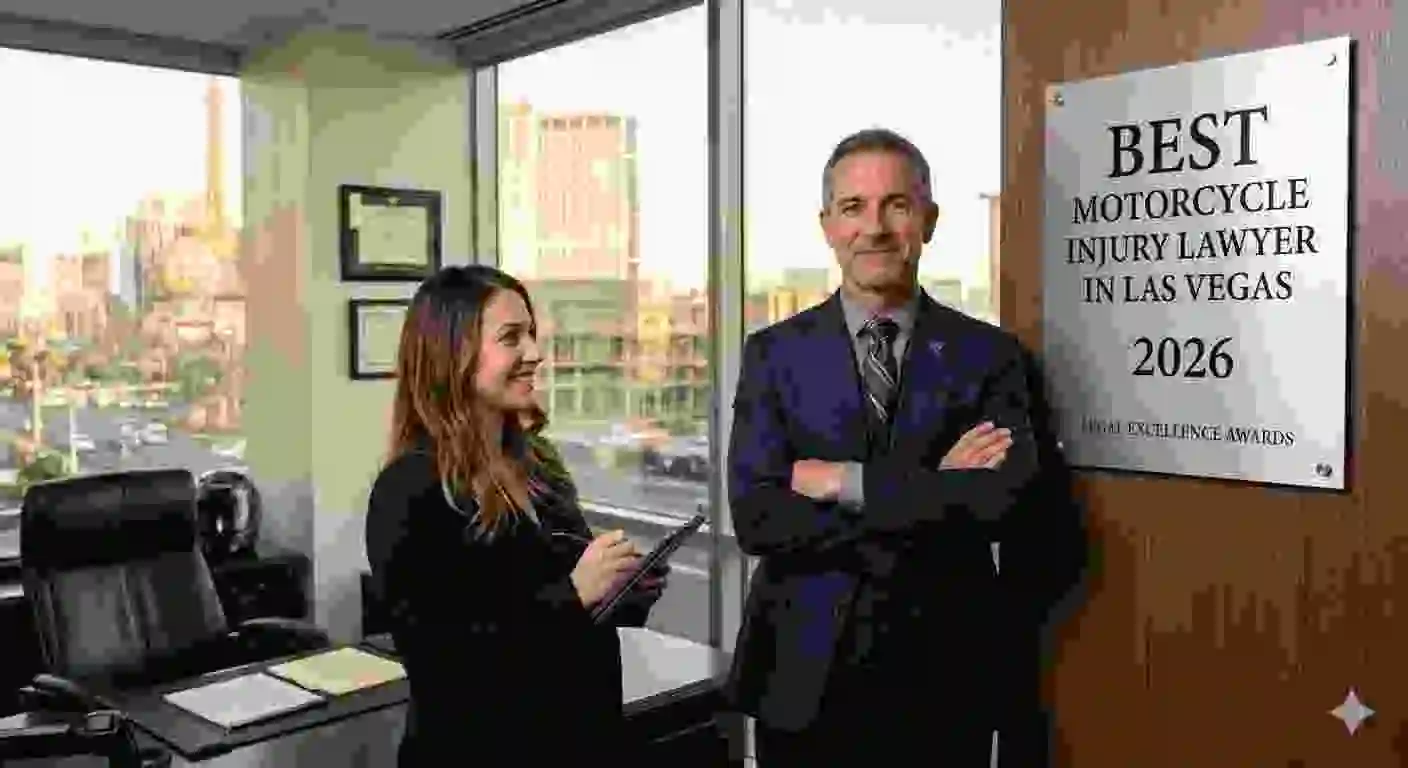
Best Motorcycle Injury Lawyer in Las Vegas 2026
You know what’s scary? One second you’re cruising down the Strip on your bike, feeling the Nevada wind, and the next second some distracted driver changes lanes without looking. Boom. Your whole life changes.
I’ve watched this happen to too many riders in Vegas. My buddy Marcus got sideswiped on Tropicana last summer. He spent three days figuring out which lawyer to call while lying in a hospital bed, worrying about bills piling up. That’s three days too long.
Let me save you that stress. I’m going to walk you through everything about finding the right motorcycle injury lawyer in Las Vegas, based on what actually works in 2026.

Why Vegas Motorcycle Accidents Hit Different
Las Vegas isn’t like other cities. The roads here present unique dangers that make motorcycle accidents particularly brutal.
The Tourist Tornado
Half the drivers here are tourists who’ve never seen our streets before. They’re gawking at the Bellagio fountains while drifting into your lane. Rental cars are everywhere, and these folks don’t know where they’re going.
I’ve seen it dozens of times on Las Vegas Boulevard. Someone from Ohio tries to make a last-second turn to catch the Mirage show, and a motorcyclist pays the price.
Desert Heat Does Damage
Summer temps hit 115°F regularly. That superheated asphalt? It gets slippery. Your tyre grip changes. The heat waves coming off the road mess with visibility. It’s a perfect recipe for accidents.
Marcus crashed on a 108-degree day. The asphalt was so hot that it literally melted part of his riding gear.
Speed Kills Here
The I-15, Highway 95, Summerlin Parkway—these roads move fast. Speed limits are high, and people drive even faster. When accidents happen at 70+ mph, motorcyclists don’t walk away with scratches.
Common Crash Spots in Vegas
| Location Type | Specific Areas | Main Danger |
|---|---|---|
| Major intersections | Flamingo & Koval, Tropicana & Paradise | Left-turn collisions |
| Highway merges | I-15 at Sahara, US-95 at Charleston | High-speed lane changes |
| Tourist zones | Las Vegas Blvd between Sahara & Russell | Distracted drivers |
| Construction areas | Downtown Project Neon zones | Debris, unclear lanes |
What Separates Great Motorcycle Lawyers from Average Ones
Not all personal injury lawyers get motorcycles. Some treat bike crashes like car accidents. That’s a huge mistake.
They Ride (Or At Least Understand Riders)
The lawyer Marcus eventually hired? Guy owns three bikes. He understood why Marcus positioned himself in the left tyre track. He knew what “target fixation” meant without Marcus explaining it.
Compare that to the first lawyer Marcus consulted, who asked, “Why didn’t you just brake?” Anyone who rides knows that sometimes braking isn’t the answer.
You want someone who gets the culture, the mechanics, and the reality of two-wheeled life.
Actual Motorcycle Case Results
When you’re researching lawyers, dig into their actual motorcycle settlements. Not just “vehicle accidents”—specifically motorcycle crashes.
Good lawyers will show you:
- Settlement amounts for bike accidents
- Cases won against Nevada insurance companies
- Experience with catastrophic motorcycle injuries
- Understanding of bike-specific laws
They Communicate Like Humans
Marcus’s lawyer texted him updates. Returned calls within hours. Explained legal jargon in plain English.
The fancy lawyer with the big billboard? His paralegal sent form emails every two weeks. Marcus had no idea what was happening with his case.
You’ll be working with this person for months. Pick someone you can actually talk to.
What to Look for in 2026
The legal world changes fast. Here’s what matters now.
Tech-Smart Legal Work
Modern motorcycle lawyers use drone footage to recreate accidents. They employ 3D modelling software. Theyanalysee traffic camera data with AI assistance.
Marcus’s lawyer used intersection camera footage and created a computer model showing exactly how the car violated right-of-way. The insurance company saw that model and settled immediately.
Electric Bike Experience
Seen all those electric motorcycles around Vegas lately? LiveWire, Zero, Energica—they’re everywhere. The laws around e-bikes are still developing.
Your 2026 lawyer needs to understand how electric motorcycle cases differ. Battery fire injuries. Regenerative braking questions. Software malfunction claims. It’s a whole new world.
Insurance Company Hardball Skills
Nevada insurance companies play rough. They’ll claim you were speeding (even if you weren’t). They’ll say you weren’t wearing proper gear. They’ll offer you $15,000 when your case is worth $150,000.
Top lawyers know these tactics inside out. They’ve dealt with Progressive, Geico, State Farm, Allstate—all the big players—and won.
Courtroom Confidence
Most cases settle out of court. But what if yours doesn’t? You need someone who’s actually tried motorcycle cases in front of Nevada juries and won.
Ask potential lawyers: “When was your last motorcycle trial, and what was the verdict?”
Red Flags That Scream “Run Away”
Marcus almost hired the wrong lawyer. Here’s what saved him.
Guaranteed Settlement Amounts
If a lawyer promises you’ll get $500,000 before even reviewing your medical records, that’s bull. Every case is different.
Honest lawyers say things like, “Based on similar cases, we might recover between X and Y, but I need to review everything first.”
Pressure to Settle Fast
Insurance companies love quick settlements. They know you’re desperate to pay medical bills. Some lawyers go along with this because they get paid faster.
Good lawyers wait until you reach maximum medical improvement. That means you’re done with surgeries, rehab, everything. Only then can you calculate true damages.
Marcus’s friend settled after six weeks for $22,000. A year later, he needed another surgery. Guess what? That settlement is gone, and he’s paying out of pocket.
Mysterious Fee Structures
Motorcycle injury lawyers typically work on contingency—they get paid when you get paid. Standard rates run 33-40% of your settlement.
This should be crystal clear from day one. If they’re dodging fee questions or the contract has confusing language, walk away.
Zero Bike-Specific Knowledge
I met a lawyer at a barbecue who asked me, “Why do motorcycles always crash in turns?”
That’s someone who doesn’t understand countersteering, target fixation, or decreasing radius turns. Would you trust them with your motorcycle injury case? Neither would I.
Finding Your Lawyer: The Actual Process
Here’s how to find someone good without wasting weeks.
Tap Into the Riding Community
Vegas has a massive motorcycle scene. Hit up:
- Local bike shops (Las Vegas Harley-Davidson, Euro Cycles)
- Riding clubs (Vegas Valley HOG, Sin City Riders)
- Online groups (Las Vegas Sportbike Riders Facebook group)
Ask riders: “If you got hit tomorrow, who would you call?”
You’ll hear the same few names repeatedly. Those are your candidates.
Online Reviews (Read Smart)
Don’t just look at star ratings. Read the actual reviews. Look for:
Good signs:
- “He understood motorcycle dynamics”
- “Communicated throughout my 14-month case”
- “Got me $X when insurance offered $Y”
- “Took my case to trial and won”
Bad signs:
- Generic “Great lawyer!” with no details
- All five-star reviews posted the same week (probably fake)
- Complaints about communication
- “They pushed me to settle”
Where to look:
- Google Reviews (most authentic)
- Avvo (check peer ratings, not just client reviews)
- Nevada State Bar website (disciplinary records)
Free Consultations Are Your Friend
Most motorcycle lawyers offer free initial consultations. Use them. Talk to at least three lawyers before deciding.
What Marcus asked:
- How many motorcycle cases did you handle last year?
- What’s your biggest motorcycle settlement?
- Have you ever taken a bike case to trial?
- Will you personally handle my case or pass it to a junior lawyer?
- How will we communicate? How often?
What he should have asked (and you should):
6. Have you dealt with my specific insurance company before?
7. What motorcycle-specific training or experience do you have?
8. Can I talk to a past client with a similar case?
Trust Your Gut
This sounds soft, but it matters. You’ll be working with this person during one of the worst periods of your life. If they give you bad vibes in the first meeting, those vibes won’t improve.
Marcus almost went with a lawyer because the guy had a fancy office. But something felt off. The lawyer checked his phone three times during their 30-minute meeting. Marcus went with someone else and never regretted it.
Your Case Timeline: What Really Happens
Let me give you the real timeline, not the glossy brochure version.
Week 1-2: Lawyer Gets to Work
Your lawyer immediately starts gathering:
- Police accident reports
- Medical records from UMC, Sunrise, or wherever you were treated
- Photos of the crash scene
- Witness contact info
- Your bike’s damage assessment
- Insurance policy details
Your job: Save everything. Every medical bill. Every prescription receipt. Every parking stub from doctor visits. Take daily photos of your injuries healing (or not healing). Write down your pain levels.
Months 1-6: Medical Treatment Continues
Don’t rush this phase. Your lawyer needs to know the full extent of your injuries before demanding money.
Marcus wanted to settle after two months because he needed cash. His lawyer said no. Good thing, because month four revealed Marcus needed a second surgery, which insurance didn’t know about yet.
Critical mistake people make: Missing medical appointments because they feel better. Insurance companies see that gap and claim you weren’t really hurt. Go to every appointment.
Month 3-8: The Demand Letter
Once doctors say you’ve reached maximum medical improvement, your lawyer sends a demand letter to insurance. This letter says, “Here’s what happened, here’s the damage, here’s what we want.”
The letter includes:
- Accident reconstruction
- Medical records and bills
- Lost wage documentation
- Expert testimony (if needed)
- Demand amount
Month 6-14: Negotiation Dance
Insurance makes a lowball offer. Your lawyer counters. They go back and forth. This phase tests your patience.
Marcus’s timeline:
- Demand: $175,000
- First offer: $28,000 (insultingly low)
- Second offer: $65,000
- Third offer: $95,000
- Counter: $150,000
- Final settlement: $127,000 (month 11)
If It Goes to Trial
Only about 5-10% of motorcycle cases go to trial. But if yours does, add another 6-18 months.
Trial happens when:
- Insurance won’t offer fair value
- Liability is disputed
- Multiple parties are involved
Marcus’s case settled, but his lawyer was fully prepared for trial. That preparation is what made insurance fold.
Mistakes That Torpedo Your Case
These are real things that have cost riders thousands or tens of thousands.
Social Media Will Destroy You
Insurance companies hire investigators to scroll your Facebook, Instagram, TikTok, and everything. That photo of you standing at your kid’s baseball game? They’ll argue you’re not really injured.
Marcus posted a photo of himself smiling at a family dinner. Insurance tried to use it to claim he wasn’t suffering. His lawyer had to explain that people in chronic pain can still smile occasionally.
Best practice: Lock down all social media. Set everything to private. Better yet, don’t post anything until your case closes.
Talking to the Other Side’s Insurance
Three days after Marcus’s crash, the other driver’s insurance called him. Super friendly. “We just need your side of the story to process this quickly.”
Marcus almost talked. Thank God he didn’t.
Never give a recorded statement to the other driver’s insurance. They will use every word against you. They’ll ask trick questions. “So you were able to walk after the crash?” becomes “Claimant admitted he wasn’t seriously injured.”
Tell them: “Please contact my attorney.” Then hang up.
Waiting Too Long
Nevada’s statute of limitations for personal injury is two years. But evidence disappears fast.
- Witnesses forget details
- Security footage gets deleted
- Skid marks fade
- Your own memory gets fuzzy
Marcus waited three weeks to hire a lawyer. By then, the convenience store camera that caught the crash had already deleted the footage.
Call a lawyer within days, not months.
Taking the First Offer
Insurance companies count on you being desperate. Medical bills are piling up. You can’t work. You need money now.
So they offer you $20,000, knowing your case is worth $100,000. If you take it, you sign away all future claims. That surgery you need six months from now? You’re paying for it yourself.
Never accept the first offer without running it by a lawyer.
Nevada Motorcycle Laws You Need to Know
Your lawyer had better know these cold.
Helmet Requirements
Nevada requires all motorcycle riders and passengers to wear helmets. No exceptions.
If you weren’t wearing one, it complicates your case but doesn’t destroy it. You can still recover damages, but the insurance company will argue comparative negligence (more on that in a second).
Lane Splitting: The Grey Zone
Here’s the thing about Nevada and lane splitting: the law doesn’t explicitly allow it, but it doesn’t explicitly ban it either.
It’s legal limbo. Some cops will ticket you. Others won’t. If you crash while lane splitting, insurance will absolutely use it against you.
Your lawyer needs to know how to argue this grey area. Marcus was filtering through stopped traffic when a car door opened into him. The insurance claimed he was riding recklessly. His lawyer successfully argued he was moving safely through congestion.
Comparative Negligence Rules
Nevada uses “modified comparative negligence with a 51% bar.”
Translation: If you’re 50% or less at fault, you can still recover damages. But they’re reduced by your percentage of fault.
Example:
- Your total damages: $100,000
- You’re found 30% at fault
- You recover: $70,000
If you’re 51% or more at fault, you get nothing.
This is why your lawyer’s skill matters. Fighting to reduce your fault percentage from 49% to 30% just puts an extra $19,000 in your pocket.
What You Can Actually Recover
Let’s talk real money.
Economic Damages (The Calculable Stuff)
Medical expenses:
- Emergency room (Marcus’s bill: $47,000 for three days)
- Surgery costs
- Physical therapy (Marcus: 6 months, $8,500)
- Future medical needs
- Medications
- Medical equipment (wheelchair, crutches, etc.)
Lost income:
- Wages during recovery
- Lost earning capacity (if you can’t return to your old job)
- Lost benefits
- Lost business opportunities
Marcus is a construction foreman. He missed four months of work. Lost wages: $28,000. But his lawyer also argued he’d lost a promotion opportunity worth $15,000 annually for the next 10 years. Insurance paid for that,t too.
Property damage:
- Motorcycle repair or replacement (Marcus’s bike totalled: $18,000)
- Riding gear (helmet, jacket, boots: $2,200)
- Other damaged property
Non-Economic Damages (The Life Impact)
This is where the real money is.
Pain and suffering: Physical pain, chronic discomfort, future pain.
Emotional distress: Anxiety, depression, PTSD from the crash.
Loss of enjoyment: Can’t ride anymore? Can’t play with your kids? Can’t do your hobbies?
Disfigurement: Permanent scars, limps, visible injuries.
Marcus has a permanent limp and serious scarring on his left leg. He can’t ride motorcycles anymore—something he’d done for 20 years. The non-economic damages part of his settlement was $75,000.
Punitive Damages (Rare But Powerful)
If the other driver was extremely reckless—drunk, street racing, intentionally dangerous—you might get punitive damages designed to punish them.
These are rare in Nevada, but when they hit, they hit big. Think drunk driver going 110 mph in a school zone level of reckless.
Real Settlement Breakdown
Here’s what Marcus actually recovered:
| Damage Type | Amount |
|---|---|
| Medical bills | $62,300 |
| Lost wages | $28,000 |
| Lost promotion value | $85,000 (present value) |
| Property damage | $20,200 |
| Pain and suffering | $75,000 |
| Total settlement | $127,000 |
| Lawyer’s fee (33%) | -$41,910 |
| Marcus received | $85,090 |
Was it worth hiring a lawyer? Insurance’s first offer was $28,000. The lawyer got him $99,000 more than that. After paying the lawyer, Marcus still pocketed $57,090 more than if he’d gone alone.
Questions to Grill Your Lawyer With
Don’t be shy. This is your life and your money.
About Their Experience
- “How many motorcycle cases are you handling right now?”
- “What was your largest motorcycle settlement or verdict?”
- “When did you last take a motorcycle case to trial?”
- “Do you ride motorcycles yourself?”
- “Have you handled cases involving [your specific injury]?”
About Your Specific Case
- “What do you honestly think my case is worth?” (Good lawyers give a range, not a guarantee)
- “What are the biggest challenges in my case?”
- “How long will this realistically take?”
- “What’s our likelihood of going to trial?”
About Communication
- “Will I work directly with you or a paralegal?”
- “How quickly do you return calls?”
- “How often will you update me?”
- “What’s your preferred communication method?”
Marcus’s lawyer texted him updates. Another friend’s lawyer only communicated through formal letters. Know what you’re getting into.
About Money
- “What’s your contingency fee percentage?” (33-40% is standard)
- “Who pays for case expenses like expert witnesses?” (Usually you, but reimbursed from the omnibus settlement)
- “What happens if we lose?” (You shouldn’t owe anything on contingency)
- “Are there any other fees I should know about?”
Making Your Final Choice
You’ve consulted with three lawyers. Now what?
Don’t Just Chase the Highest Number
If one lawyer says your case is worth $500,000 and two others say $150,000, the high-baller is probably blowing smoke to sign you up.
Pick the lawyer who gives you realistic expectations with solid reasoning.
Chemistry Matters
You’ll talk to this person dozens of times over the next year. Pick someone you actually like talking to.
Marcus clicked with his lawyer immediately. They talked about bikes for 20 minutes before even discussing the case. That rapport helped during the stressful months that followed.
Check the Nevada State Bar
Go to nvbar.org and verify:
- They’re licensed in Nevada
- No disciplinary actions
- How long have they been practicing
- Any specializations
This takes five minutes and could save you from a disaster.
Read the Contract Carefully
Before signing anything, understand:
- Exact fee percentage
- Who pays what expenses
- How can you fire them if needed
- What happens if you’re unsatisfied
Marcus had a lawyer friend review his contract before signing. Good move.
Life After the Accident
Getting a settlement helps, but it’s not everything.
Focus on Healing First
Money doesn’t matter if you don’t heal properly. Follow every doctor’s order. Do your physical therapy. Take your medications.
Marcus got frustrated with PT and wanted to quit. His lawyer told him bluntly: “If you stop treatment, insurance will argue you’re fine and cut our settlement in half.”
That kept Marcus going.
Document Like Your Settlement Depends on It
Because it does.
Keep a daily journal:
- Pain levels (1-10 scale)
- What you couldn’t do that day
- Medical appointments
- How injuries affected work, family, hobbies
- Emotional state
Marcus’s journal became powerful evidence. “Can’t sleep due to leg pain” for 90 consecutive days made a huge impact.
Be Patient With the Process
Marcus’s case took 11 months. That felt like forever when he was hurting and broke.
But his lawyer moved as fast as possible while still building a strong case. Rushing would have cost Marcus $50,000+.
Know When to Get Back on a Bike
This is personal. Marcus hasn’t ridden since his crash. Might never ride again. His buddy got back on a bike six months after a similar crash.
No judgment either way. Do what feels right for you.
The Bottom Line
Finding the best motorcycle injury lawyer in Las Vegas isn’t about the biggest billboard or the fanciest office.
It’s about finding someone who:
- Actually understands motorcycle culture and mechanics
- Has proven motorcycle case results
- Communicates like a real human
- Will fight insurance companies hard
- Makes you feel confident and comfortable
Marcus found that person, and it changed everything. His settlement covered his medical bills, replaced his lost income, and gave him a financial cushion while he figured out his next career move.
You can find that person, too. Start with the riding community. Consult with multiple lawyers. Ask tough questions. Trust your instincts.
And do it soon. Evidence disappears. Witnesses forget. Your case gets stronger the faster you act.
You didn’t ask to get hit by that careless driver. But you can control what happens next. Find the right lawyer, and give yourself the best shot at fair compensation and justice.
Stay safe out there, and remember—we riders look out for each other, on the road and off.
links:-
- How to Deal with Recovery Agents (Legal Guide)
- https://www.accidentlawgroup.com/motorcycle-accident-lawyer/
About The Author