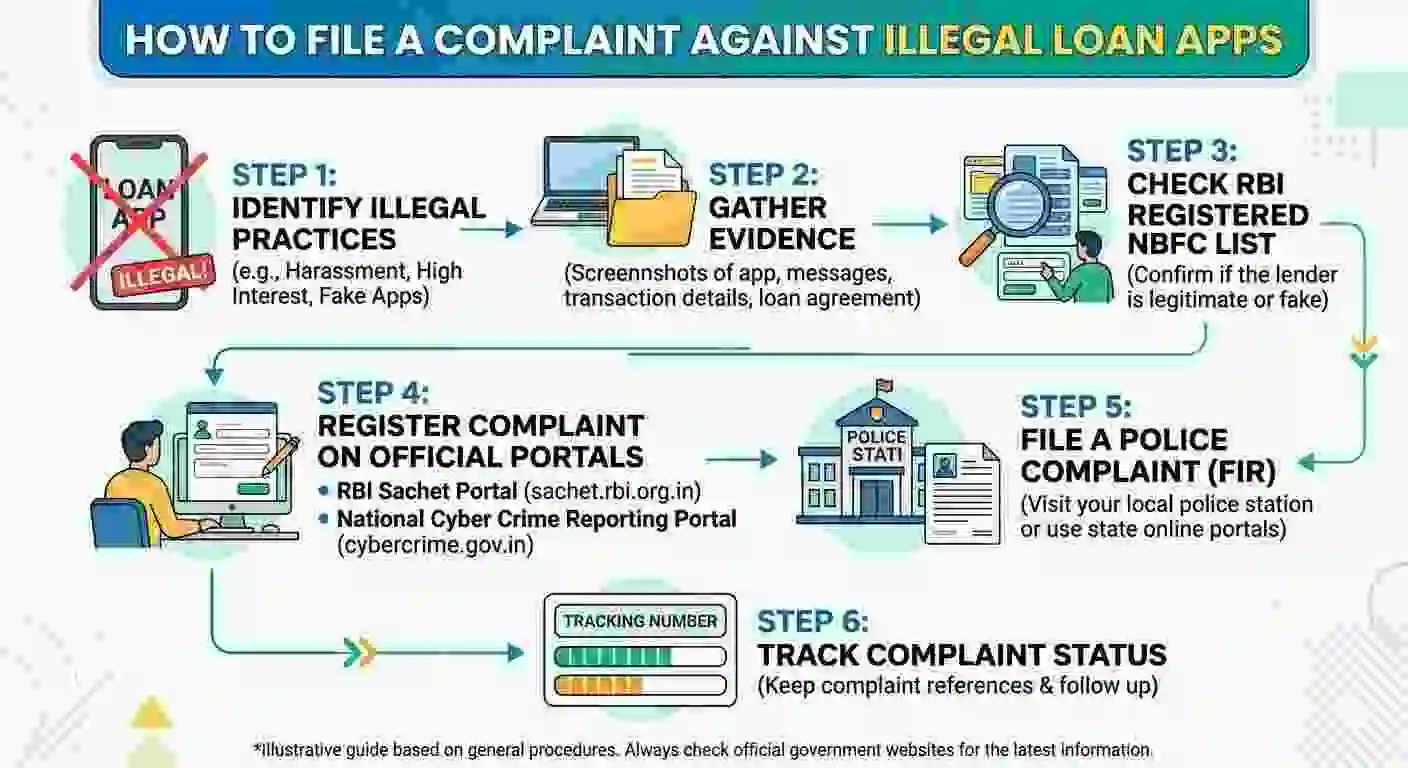
How to File a Complaint Against Illegal Loan Apps
Look, I’ll be completely honest with you. Two years ago, my younger brother Arjun downloaded one of these “instant loan” apps because his friend’s wedding was coming up and he was short on cash. What started as a ₹10,000 loan turned into the worst three months of our family’s life.
They didn’t just call him. They called my elderly parents at 11 PM, sent morphed pictures of Arjun to his office WhatsApp group, and even contacted his ex-girlfriend from college. I watched my confident brother break down crying because some stranger was threatening to “ruin his life” over ₹15,000.
That experience changed everything. We fought back, we won, and now I’m sharing exactly what we learned so you don’t have to go through what we did.
Understanding Illegal Loan Apps
Before we jump into filing complaints, let’s get clear on what makes a loan app illegal in the first place. And trust me, once you understand this, you’ll realise you have way more power than these bullies want you to believe.
What Makes a Loan App Illegal?
Not every loan app that charges high interest is illegal, but here’s what crosses the line:
- No proper RBI registration – Legitimate lenders must be registered. I learned this the hard way when we checked Arjun’s app and found absolutely nothing on the RBI website.
- Accessing your contacts without consent – They dig through your phone like it’s their personal property. Arjun’s app accessed 347 contacts within minutes of installation. We only found out when his childhood friend from Kerala called, asking why he got a message about Arjun’s loan.
- Charging interest rates above 36% annually – Anything beyond this is usury. The app my brother used was charging 2% daily. Do the math – that’s 730% annually! Absolutely criminal.
- Threatening or abusing borrowers – No one has the right to harass you. The recovery agent told my mother, “Your son will be in jail by Monday.” It was Thursday. My mom didn’t sleep for two nights.
- Accessing personal photos and data – This is a massive privacy violation. They pulled photos from Arjun’s gallery, including family pictures from our sister’s wedding.
- Not providing clear loan terms – Hidden charges everywhere. What was advertised as ₹10,000 became ₹10,000 + ₹2,000 processing fee + ₹500 “platform fee” + insurance nobody asked for.
Common Red Flags
Watch out for these warning signs. I wish someone had shown this to Arjun before he downloaded that cursed app:
| Red Flag | What It Looks Like | My Brother’s Experience |
|---|---|---|
| Unrealistic approval times | “Get money in 5 minutes!” | His loan was “approved” in 3 minutes flat |
| Excessive permissions | Asking for gallery, contacts, and messages access | Required 18 permissions, including SMS and location |
| No physical address | Can’t find their actual office location | The address was a residential flat in some random city |
| Unclear terms | Processing fees that make no sense | ₹2,500 in fees for a ₹10,000 loan |
| Immediate harassment | Start threatening before the due date | Calls started 2 days before the actual due date |
My Personal Wake-Up Call
I’ll never forget the Saturday morning when Dad got a call on his phone. The person on the other end said, “Your son Arjun has taken money from us and is refusing to pay. You should control your son, or we’ll take legal action.”
My father, who’s 68 and has high blood pressure, was shaking. That’s when I realised this wasn’t just about money anymore. This was about protecting my family’s dignity and mental peace.
Why You Should Definitely File a Complaint
I get it. You might think, “Why bother? They’re too powerful. They have my data. What if they make things worse?”
Let me tell you something from personal experience – these companies are absolutely terrified of government authorities. They’re operating illegally, and they know it. One solid complaint can shut down their operations or at least get them off your back.
Real Results I’ve Witnessed
My colleague Suresh filed a complaint last year against an app that was messaging his entire contact list. Within two weeks, the harassment stopped completely. The company even waived the ridiculous penalty charges of ₹8,000 and settled for just the principal amount.
My neighbour Anjali in Pune took the legal route. She filed complaints with the RBI, the cybercrime cell, and the consumer forum simultaneously. The app’s customer care, which never picked up her calls for three weeks, suddenly called her within 4 days, offering to “resolve the matter amicably.”
In Arjun’s case, we filed complaints everywhere (I’ll tell you exactly how in a minute). The harassment stopped in 9 days. Nine days! After three months of hell, just nine days of fighting back legally changed everything.
Step-by-Step Guide to Filing Your Complaint
Right, let’s get down to business. Here’s exactly what you need to do. I’m writing this like I’m sitting across from you with a cup of chai, explaining step by step, because that’s exactly what I did with my brother.
Step 1: Gather Your Evidence
Before you file anything, collect proof. This is super important. I cannot stress this enough.
What you need:
When we started collecting evidence for Arjun’s case, I created a folder on his phone called “Loan Evidence.” Here’s what went in there:
- Screenshots of abusive messages or calls – We had 47 screenshots. Some messages were so vulgar that I couldn’t even repeat them here. But we documented everything.
- Call recordings – I downloaded an automatic call recording app on Arjun’s phone. Recorded 23 calls. One recovery agent actually said, “I’ll come to your house and break your legs.” On recording. Can you believe the audacity?
- Loan agreement or screenshots of terms – The app conveniently didn’t have a downloadable agreement. So we took screenshots of every single page showing loan amount, interest, fees, everything.
- Transaction history showing payments made – Arjun had already paid ₹12,000 against the original ₹10,000 loan, but they were demanding ₹18,000 more. Bank statements proved he’d paid.
- Screenshots of app permissions – We went to Settings > Apps > Permissions and took screenshots showing what access the app had taken.
- Details of who they contacted – Made a list of 23 people they had messaged or called, with dates and times.
- Any emails or messages from the company – They’d sent three threatening emails. Saved all of them.
Store everything in a separate folder. Back it up on cloud storage, too. We used Google Drive because we didn’t want to lose anything.
Step 2: File a Complaint with RBI Ombudsman
The Reserve Bank of India takes these matters seriously. This was our first official complaint, and honestly, it felt empowering.
How to do it (exactly how I did it):
I sat with my laptop on a Sunday afternoon. Arjun was next to me. We went to the RBI CMS Portal together.
- Visit the RBI CMS Portal ()
- Click on “File a Complaint” – It’s a big orange button, you can’t miss it
- Choose “Against NBFCs” if it’s a lending company – We chose this even though we weren’t sure if they were registered
- Fill in all details accurately – I took my time. Filled every field properly. Name, address, loan details, everything.
- Upload your evidence – You can upload up to 5 files. I combined screenshots into PDF files to fit everything.
- Submit and note down your complaint reference number – Got reference number RBIO/2023/XX/XXXXX. Wrote it down in three different places.
Important points from my experience:
- You can file online or through a written application – Online is faster, trust me
- No fees required – Not a single rupee
- You’ll get a reference number – Save it like your life depends on it
- RBI typically responds within 30 days – We got a response in 18 days
My honest experience: Filing the RBI complaint gave Arjun hope for the first time in weeks. He said, “At least someone official knows what’s happening now.” That psychological relief was worth it alone.
Step 3: Report to Cybercrime Portal
Since most of these apps operate online, this is crucial. I filed this complaint on the same day as the RBI complaint. Strike while the iron is hot, as they say.
Process (step by step):
- Go to https://cybercrime.gov.in
- Click “Report Other Cyber Crimes” – It’s right on the homepage
- Select “Financial Fraud Crimes” from the dropdown
- Choose relevant sub-category – I selected “Harassment related to digital lending apps”
- Provide complete details – They ask for incident details, suspect details, everything. I wrote a detailed paragraph explaining the harassment.
- Attach all evidence – Uploaded call recordings, screenshots, everything
- Submit complaint
You’ll receive an acknowledgement number. Mine was ACK-XXXXXX/2023. Keep it safe.
Real experience: Within 3 days, I got an email saying my complaint had been forwarded to the concerned state police cybercrime unit. That was faster than I expected.
Step 4: Lodge FIR at Police Station
Yes, you can file an actual police complaint. This was the part I was most nervous about, but it turned out to be crucial.
I went to our local police station on a Tuesday morning. Took Arjun with me, along with all the printed evidence in a file folder.
Here’s what happened:
The duty officer initially seemed reluctant. He said, “This is a civil matter, not criminal.” I politely but firmly said, “Sir, harassment is criminal. I have evidence of threats and privacy violations. I can file this FIR here, or I can go to the SP office and file it there along with a complaint about non-cooperation.”
That changed his tone immediately.
Visit your local police station and file an FIR for:
- Harassment (IPC Section 506) – For the threatening calls and messages
- Criminal intimidation – They threatened physical harm
- Extortion (IPC Section 384) – Demanding money through threats
- Privacy violation (IT Act Section 66E) – Accessing photos without consent
- Defamation (if they contacted others) – They sent messages to Arjun’s contacts
Pro tip from my experience: If the local police seem reluctant (and some will be), mention that you’ll file a complaint with the SP office or use the online FIR facility. They usually cooperate after that. Also, mention you’ve already filed cybercrime and RBI complaints. It shows you’re serious.
Our FIR experience: The FIR was registered under sections 384, 506, and the IT Act 66E. FIR number was XXX/2023. Got a copy immediately. The sub-inspector actually said, “These apps are a menace. You’ve done the right thing.”
That validation meant everything to my brother.
Step 5: Complaint to NBFC Association
If the app claims to be an NBFC, report them to:
Finance Industry Development Council (FIDC)
I sent them an email four days after filing the RBI complaint.
What I wrote:
Subject: Harassment by Illegal Lending App - Complaint

Dear Sir/Madam,

I am writing to file a formal complaint against [App Name] for illegal lending practices and harassment.

Details:
- Loan Amount: ₹10,000
- Borrowed by: Arjun [Full Name]
- Date of loan: [Date]
- RBI Complaint No: RBIO/2023/XX/XXXXX
- Cybercrime Complaint No: ACK-XXXXXX/2023
- FIR No: XXX/2023

The company has engaged in:
1. Harassment through calls and messages
2. Contacting family members
3. Accessing personal data without consent
4. Charging excessive interest rates (730% annually)

Please find attached evidence of all violations.

I request immediate action against this company.

Regards,
[My Name]- Email: contact@fidc.in (sent with all attachments)
- Provided evidence and reference numbers from other complaints
- Got an auto-reply immediately, actual response in 6 days
Step 6: Consumer Forum Complaint
For financial compensation and justice, this works brilliantly. We filed this after the harassment stopped, because we wanted compensation for the mental trauma.
Choose based on loan amount:
| Loan Amount | Forum Type | Filing Fee | Our Experience |
|---|---|---|---|
| Up to ₹1 lakh | District Forum | ₹100-200 | We filed here (loan was ₹10,000) |
| ₹1-10 lakh | State Forum | ₹200-500 | – |
| Above ₹10 lakh | National Forum | ₹500-5000 | – |
You can file online through the e-Daakhil portal ().
Our consumer forum journey:
We filed at the District Consumer Forum. Paid ₹150 as filing fee. The hearing happened after 2 months. We presented all our evidence – screenshots, call recordings, bank statements, everything.
The forum ordered:
- The company will refund the excess amount Arjun had paid
- Pay ₹25,000 as compensation for mental harassment
- Pay ₹5,000 for legal expenses
Total: ₹30,000 plus refund. The order took 4 months from filing to judgment.
Honest reality check: The company didn’t show up for the hearing. We won by default. Getting them to actually pay the compensation took another 3 months and a recovery notice. But we got every rupee.
Step 7: Complaint to Google Play Store / App Store
Get the app removed entirely. This is important not just for you, but for thousands of others who might download it.
For Google Play (how I did it):
- Opened the app page on my phone
- Scrolled down and tapped “Flag as inappropriate”
- Choose “Fraud or illegal activity”
- Provided detailed explanation: “This app engages in illegal lending practices, harasses borrowers, accesses personal data without consent, and violates RBI guidelines. FIR filed under [number]. Please remove immediately.”
- Submitted
For Apple App Store (similar process):
- Open App Store
- Find the app
- Click “Report a Problem”
- Choose “Fraud”
- Explain the issue in detail
Result: The app was suspended from the Play Store 12 days after I reported it. I checked. It said, “This app is no longer available.” That felt like a huge victory.
Multiple complaints get apps suspended quickly. I also asked five friends to report the same app. Every report counts.
Immediate Steps to Stop Harassment
While your complaints are being processed, protect yourself immediately. This is what we did on Day 1 itself, even before filing official complaints.
Block and Document
What we did immediately:
- Blocked all numbers they called from – They were calling from 7 different numbers. Blocked all. They started calling from new numbers. Blocked those too. Eventually, they gave up.
- Didn’t delete messages – screenshot first – This was crucial. Arjun’s first instinct was to delete the abusive messages because they were so hurtful. I stopped him. “Every message is evidence,” I said.
- Installed a call recording app – Downloaded “Automatic Call Recorder” from the Play Store. Recorded every conversation. Legal in most states, but check your local laws.
- Kept a diary of harassment incidents – I created a Google Doc. Every day, we’d note down: Date, time, who called, what they said, who they contacted. This diary later became powerful evidence in a consumer forum.
Sample entry from our diary:
Date: 15/03/2023
Time: 10:47 PM
Called: Arjun's phone
Person: Male, claimed name was "Rajesh"
What happened: Threatened legal action, used abusive language, said "we know where you live"
Action taken: Call recorded, screenshot saved
Protect Your Data
Do this right now (literally, stop reading and do this):
When I realised the extent of data access these apps have, I panicked. But then I systematically fixed everything.
- Uninstall the app immediately – We uninstalled it that very day. Some apps hide the uninstall option. Go to Settings > Apps > [App Name] > Uninstall. Force it if needed.
- Change passwords of all linked accounts – Arjun had used his Gmail for registration. Changed Gmail password. Changed bank app password. Changed everything.
- Review and revoke app permissions – Went to Settings > Apps > App permissions > checked every single app on his phone. Revoked unnecessary permissions from so many apps.
- Check your phone for any suspicious apps – Found two apps we didn’t recognise. Turned out the loan app had somehow installed a “companion app” for “verification.” Deleted immediately.
- Factory reset if necessary (backup first) – We didn’t need to do this, but if you suspect deep malware, do it. Back up your important stuff tothe cloud first.
My experience with data protection: Three days after uninstalling the app, Arjun got an email saying, “We noticed you uninstalled our app. Reinstall within 24 hours or face penalties.” Can you imagine? We ignored it. It was a bluff.
Inform Your Contacts
I know it’s embarrassing, but trust me on this. We struggled with this decision for two days.
Finally, I told Arjun, “Your dignity is more important than their lies. Let’s control the narrative.”
What we did:
Sent a simple message to close contacts (about 50 people – family, close friends, office colleagues):
"Hi, I want to inform you that I've been targeted by a fraudulent loan app that may contact you with false information about me. If you receive any calls, messages, or friend requests regarding me or any financial matter, please ignore them completely. I've already filed police complaints (FIR No. XXX/2023) and legal action is underway. Thanks for your understanding. - Arjun"The response?
Overwhelming support. Seriously.
My aunt called and said her son had gone through the same thing. Arjun’s friend Vikram said he’d almost downloaded the same app last month. Three colleagues shared their own scary loan app experiences.
Not a single person judged him. Instead, people respected his courage to speak up.
Important lesson: Most people are understanding. It also prevents the app from manipulating your relationships. One of Arjun’s contacts actually called back the recovery agent and threatened to file a police complaint for harassment. The agent never contacted that person again.
Legal Rights You Should Know
Understanding your rights makes you powerful. I spent an entire evening researching this because I wanted to know exactly where we stood legally.
Your Consumer Rights
- Right to privacy – They cannot access your data without your explicit consent for that specific purpose. Just because you permitted contacts doesn’t mean they can message them.
- Right to fair collection – Even if you owe money, harassment is illegal. Collection must be done through legal means only.
- Right to transparency – All charges must be clearly stated before you borrow. Hidden fees are illegal.
- Right to complaint – You can approach authorities without fear. They cannot threaten you for filing complaints.
What They Cannot Do Legally
Let me be crystal clear about this, because knowing these boundaries helped us stay strong:
Illegal actions by loan apps:
- Calling you after 7 PM or before 7 AM – They called Arjun at 11:30 PM. Illegal.
- Contacting your family, friends, or colleagues – They called Dad, Mom, two cousins, and three office colleagues. All illegal.
- Using abusive or threatening language – “I’ll break your legs” – is recorded and illegal.
- Morphing your photos – They created a fake “WANTED” poster with Arjun’s photo. Illegal and actionable.
- Sharing your personal information publicly – They posted his number in a “defaulters” Telegram group. Illegal.
- Visiting your home or workplace – They threatened to visit his office. If they had, we’d have called the police immediately.
- Charging undisclosed fees or penalties – Every charge they added after the loan was disbursed was illegal.
If they do any of this, you have a rock-solid case against them. And I mean rock-solid. These aren’t grey areas. These are clear legal violations.
What to Expect After Filing Complaints
Let’s set realistic expectations. I want you to know exactly what happened in our case, timeline and all.
Timeline (Our Actual Experience)
- Day 1-3 (Immediate): Filed all complaints. Got acknowledgement from RBI and the cybercrime portal. FIR registered. Felt like we’d done something instead of just suffering.
- Day 4-9 (First week): Harassment continued, but we didn’t engage. Just documented everything. On Day 7, the app’s “senior manager” called, ed offering to “discuss.” We said, “Talk to the police or consumer forum.”
- Day 9: Harassment stopped completely. No calls. No messages. Radio silence.
- Week 2-4 (Short-term): Got emails from RBI saying they’re investigating. Cybercrime unit called Arjun once to verify details. Police called the company (we found out later).
- Month 2-3 (Medium-term): RBI sent us a detailed responsThe companyany claimed they’d “close the account.” Cybercrime said they’re building a case against multiple such apps.
- Month 4-7 (Long-term): Consumer forum hearings. The company didn’t appear. We won. The recovery process started.
Possible Outcomes (What Actually Happens)
Based on what happened to five other people and me, I personally know who fought these apps:
- Company contacts you to settle – They called us on Day 7. Offered to “waive all penalties” if we paid the principal. We said no, we’re going through legal channels. Eventually, they paid us.
- Harassment stops – This happened in all six cases I know. Once companies realise you’re serious about legal action, they back off. They have hundreds of other victims who aren’t fighting back. They focus on them.
- Account gets blocked – They “closed” Arjun’s account. Fine by us.
- Legal action against the company – The cybercrime unit told us they’re investigating 47 similar apps. Some have been shut down. It’s a slow process, but it happens.
- Compensation – We got ₹30,000. Suresh got ₹40,000. Anjali got ₹15,000, plus they waived her entire loan. It varies, but justice dohappen. Truththh: The process is slow. It’s frustrating. There were days Arjun wanted to just pay them and be done with it. But we stuck to it, and we won.
Additional Support and Resources
You’re not fighting this alone. I wish someone had told us about all these resources earlier.
Helplines and Organizations
Key contacts (we used all of these):
- RBI Complaint Helpline: 14448 – Called them twice. They guided us on the complaint process. Patient and helpful.
- National Cybercrime Helpline: 1930 – Called when we were confused about filing the online complaint. They walked us through it step by step.
- Consumer Helpline: 1915 – Helped us understand the consumer forum process.
- Legal Services Authority: 15100 – Gave us free legal consultation.
My experience: Don’t hesitate to call these numbers. They’re there to help. The person at 1930 spent 20 minutes on the phone with me, explaining everything. Government helplines can be surprisingly helpful.
Online Support Communities
Join groups where people share experiences. This was a lifesaver for our mental health.
- Facebook groups on consumer rights – I joined “Digital Lending Harassment Victims Support Group” (name changed for privacy). 15,000+ members. Real people, real stories, real solutions.
- Reddit communities – r/LegalAdviceIndia has threads on loan app issues. Found the exact script for what to say at the police station there.
- Twitter – Use hashtags like #IllegalLoanApps #DigitalLendingHarassment. People share their experiences. I even found a lawyer who specialises in these cases through Twitter.
What helped us most: Reading success stories. Knowing that 500 other people had fought back and won gave us courage.
Free Legal Aid
If you can’t afford a lawyer (we couldn’t initially):
- District Legal Services Authority offers free legal help – We went there. They assigned us a lawyer for the consumer forum case. Completely free.
- NALSA (National Legal Services Authority) provides aid – They have offices in every district court complex.
- Many NGOs help with consumer cases – Found one NGO in our city that specifically helps loan app harassment victims.
Contact your local legal aid cell through your district court. Just walk in and ask. They’re required to help.
Our experience: The free legal aid lawyer was actually better than some paid lawyers we’d consulted. She’d handled 30+ such cases. Knew exactly what evidence to present, what arguments to make.
Preventing Future Problems
Once you sort this mess out, let’s make sure it never happens again. I made Arjun promise he’d follow these rules, and I’m sharing them with you.
How to Identify Legitimate Loan Apps
Check these before downloading (I created a checklist for Arjun):
✅ RBI registration – Go to the RBI website, check the list of registered NBFCs. If the company isn’t there, don’t download. Period.
✅ Clear company details with physical address – Google the address. Does the office actually exist? We found one app that listed a residential apartment as its “head office.”
✅ Transparent interest rates – If they’re advertising “low interest” but not showing the exact rate, red flag.
✅ Proper customer service – Call their customer care before borrowing. If no one picks up, imagine trying to reach them when there’s a problem.
✅ Minimal app permissions – Why does a loan app need access to your gallery? It doesn’t.
✅ Positive reviews from verified users – Read 1-star reviews first. They tell the real story. One-line five-star reviews are usually fake.
Real example: Before writing this, I tested this checklist on 5 popular loan apps. Only 2 passed all checks. Those are the only ones I’d ever recommend to anyone.
Better Alternatives to Quick Loan Apps
Instead of dodgy apps, consider these. I researched all of them after Arjun’s nightmare:
- Bank personal loans – Lower interest (10-15% annually), regulated, safe. Takes 2-3 days, but worth the wait.
- Credit cards – Safer for short-term needs. Even credit card interest (36% annually) is way lower than these apps (300-700% annually).
- Gold loans – Quick (same day) and legitimate. If you have gold, this is your best option. Interest around 10-12% annually.
- Employer advances – No interest usually. Many companies offer a salary advance. Arjun’s company actually did, he just didn’t know.
- Credit unions – Community-based lending. Lower interest, flexible repayment.
Personal recommendation: After everything we went through, I told Arjun – if you ever need money urgently again, ask me, ask friends, pawn something, take a bank loan, but never touch these apps.
Building Financial Safety
Look, I’m not here to lecture you about money management, but having an emergency fund seriously reduces the need for these apps.
Practical approach (what worked for our family):
Arjun started saving ₹1,000 monthly after this incident. Some months, he could only manage ₹500. That’s okay.
Even ₹500 saved monthly becomes ₹6,000 in a year. That’s enough to avoid most emergency loan situations.
How we did it:
- Automatic transfer to a separate savings account on salary day
- Treat it like a non-negotiable expense
- Don’t touch it unless genuine emergency
Two years later: Arjun has ₹35,000 in his emergency fund. Last month, his laptop broke. Instead of panicking and downloading some app, he used his savings. Bought a new laptop, still had ₹20,000 left.
That’s freedom. That’s peace of mind.
Real Stories from Real People
Let me share what actually happened to people who fought back. These are real people I personally know or spoke to during our journey.
Rahul’s Story (Bangalore) – Detailed Version
I met Rahul in the Facebook support group. His story gave us courage.
Rahul borrowed ₹5,000 from an app called “QuickCash” (name changed) for his daughter’s school fees. The app showed interestats ₹500. Seemed reasonable.
Within a week, they demanded ₹12,000. When he questioned, they showed “late fees” of ₹4,000 and “penalty charges” of ₹2,500. The loan wasn’t even due yet.
When he refused to pay, they sent his morphed photos to 50 contacts. Made it look like Rahul was on a “wanted criminals” list. His wife’s cousin called from Dubai asking if everything was okay.
What Rahul did:
- Filed a cybercrime complaint with all screenshots
- Filed an RBI complaint with evidence of usurious interest
- Filed a consumer forum complaint for defamation and mental harassment
- Filed FIR under the IT Act and IPC sections
Timeline:
- Week 1: All complaints filed
- Week 3: App’s operations were suspended (other complaints had piled up, too)
- Month 2: Consumer forum hearing
- Day 45:The appp company sent a lawyer to settle. Rahul refused.
- Month 4: Consumer forum awarded ₹50,000 compensation for mental harassment plus a refund of ₹7,000 excess paid
Current status: Rahul received ₹57,000. The app is no longer on the Play Store. He now runs a WhatsApp group helping others file similar complaints.
What Rahul told me: “The day I filed those complaints, I slept peacefully for the first time in two weeks. Taking action gave me back my power.”
Priya’s Experience (Mumbai) – The Office Harassment Case
Priya’s situation was different and particularly cruel. She borrowed ₹4,000 for her mother’s medicines.
The app was calling her office reception 20-30 times a day. Her boss called her and said, “Priya, some recovery agency is calling for you. Is everything okay?”
She was mortified. She’s a senior accountant at a CA firm. This was destroying her professional reputation.
What Priya did (her timeline):
Day 1: Filed FIR at Bandra police station for harassment and defamation. Police were initially reluctant. She showed them 67 screenshots of calls to her office. FIR registered.
Day 2: Complained to RBI through the online portal.
Day 3: Reported to Google Play Store with FIR number.
Day 5: Sent legal notice through a lawyer friend (cost her ₹2,000).
Day 10: App was removed from the Play Store (multiple people had reported it by then).
Day 12: The company called her, offering to settle for just the principal amount (₹3,000 instead of the demanded ₹8,500).
What she did: Negotiated further. Finally settled for ₹2,500 (less than even the principal because of the harassment). Got written confirmation that her account was closed and they’d destroyed all her data.
Current status: Priya is fine. Her office never found out the full extent. The app is gone.
Priya’s advice: “Don’t wait for things to get worse. File complaints immediately. The sooner you fight back, the sooner it stops.”
My Brother Arjun’s Story – The Complete Journey
I’ve been mentioning Arjun throughout this article. Let me give you the complete picture.
Background: Arjun, 29, works in IT. Earns a decent salary but was managing some family medical expenses. His friend’s wedding came up, needed ₹10,000 urgently.
The Mistake: Downloaded “InstaMoney” (name changed) based on a Facebook ad. App had 4.2 stars (later realised reviews were fake).
The Trap:
- Applied for ₹10,000
- App showed a processing fee of ₹2,000
- Received only ₹8,000 in bank (they deducted ₹2,000 upfront)
- But repayment was still ₹10,000 + ₹1,500 interest
- Repayment due in 15 days
The Nightmare:
Day 10: Started getting calls. “Pay now or face consequences.”
Day 12: Calls increased to 30-40 per day.
Day 13: They called our parents. Dad got 5 calls in one evening.
Day 14: Sent messages to 23 people from his contact list.
Day 15 (Due date): Arjun paid ₹12,000 (the demanded amount).
Day 16: They demanded ₹6,000 more as “late fee” (the loan wasn’t even late!).
Day 17: Arjun paid ₹6,000 more (total paid: ₹18,000 against a ₹10,000 loan).
Day 18: They demanded another ₹3,000.
Day 19: Arjun broke down. Told me everything.
The Fight Back:
Day 20 (Sunday): I spent the whole day researching. Found the Facebook support group. Learned about the complaint process.
Day 21 (Monday):
- 10 AM: Filed RBI complaint online
- 2 PM: Filed cybercrime complaint
- 4 PM: Went to the police station, filed FIR
Day 22-27: Harassment continued. We didn’t engage. Just documented everything.
Day 28: “Senior Manager” called. Offered to “close the matter” for ₹5,000 more. We refused.
Day 29: Harassment stopped completely.
Day 35: Filed consumer forum complaint.
Month 2: RBI responded, saying they’re investigating.
Month 4: Consumer forum hearing. The company didn’t appear.
Month 5: Consumer forum judgment: Company to refund ₹8,000 excess paid + ₹25,000 compensation + ₹5,000 costs.
Months 6-8: Recovery process. Sent notice. The company ignored.
Month 9: Court-ordered recovery through revenue authorities.
Month 11: We received ₹38,000 (full amount).
Current status (2 years later):
Arjun has completely recovered mentally. Has an emergency fund. Helps others in the Facebook group. The app is no longer operational (shut down after multiple FIRs).
What Arjun says now: “I lost ₹18,000, but I gained knowledge and confidence. If I hadn’t fought back, I’d still be living in fear. Now I know my rights, and I’m not afraid of these bullies.”
Common Mistakes to Avoid
Don’t make these errors that weaken your case. I’m sharing these because we made some of these mistakes initially.
What Not to Do
- Don’t pay under pressure – This was our biggest mistake. Arjun paid ₹18,000 before we started fighting back. That money took extra effort to recover. If we’d filed complaints on Day 15 itself, we’d have saved so much stress.
- Don’t ignore the issue – It only gets worse. My neighbour ignored harassment for 3 months. By the time he acted, they’d contacted 200+ people. Damage control became 10 times harder.
- Don’t take new loans to pay old ones – Debt trap guaranteed. Arjun almost downloaded another app to payfor the first one. I stopped him just in time.
- Don’t negotiate before filing complaints – File first, negotiate later. Once you file complaints, you negotiate from a position of strength.
- Don’t share more personal information – They asked Arjun for his PAN card “to restructure the loan.” Thankfully, he didn’t send it.
What You Should Do
- Document everything thoroughly – Cannot stress this enough. We won our case because we had 200+ pieces of evidence.
- File multiple complaints simultaneously – Don’t file one and wait. File everywhere at once. Create pressure from all sides.
- Stay calm and factual in communications – We were angry, hurt, scared. But in all official complaints, we stuck to facts. Emotions don’t help in legal matters.
- Follow up on your complaints regularly – Check status every week. We sent follow-up emails to RBI every 10 days.
- Seek support from family or friends – Arjun initially tried to handle it alone. When he told me, we fought together. Made all the difference.
Frequently Asked Questions
These are actual questions people asked us, and questions we had during our journey.
Will filing a complaint affect my credit score?
Short answer: No.
Detailed answer: Complaints against illegal apps don’t affect your CIBIL score. In fact, if the app isn’t RBI-registered, they probably can’t report to credit bureaus anyway.
We checked Arjun’s CIBIL score before and after the whole process. No change. Actually, his score improved later because he started managing finances better.
Exception: If the app is a legitimate, RBI-registered NBFC and you genuinely defaulted on a legal loan, that might affect your score. But harassment is still illegal even then.
Can they really send my photos to contacts?
Short answer: Yes, they can, and they do.
Detailed answer: They threaten this often, and sadly, some do it. That’s exactly what happened to Rahul. They accessed his photo gallery (because hpermittedng installation) and morphed his photos onto fake “wanted” posters.
Why filing complaints immediately is crucial: It’s illegal under the IT Act Section 66E. Authorities take it very seriously. The faster you report, the faster it stops.
Prevention: Never give gallery access to loan apps. If you already did, revoke it immediately.
What if I actually owe them money?
Great question. This is the guilt many people feel.
Answer: Even if you borrowed money legitimately, harassment is illegal. Period.
File complaints first. Stop the harassment. Then deal with the financial aspect separately.
What usually happens: Once you file complaints, companies become willing to settle reasonably. Arjun actually owed ₹10,000 (the principal) + reasonable interest (maybe ₹500-1,000). Everything else was illegal charges.
Through the legal process, you typically end up paying only what’s fair. Sometimes less, if you can prove harassment caused you damage.
Remember: Owing money doesn’t give them the right to threaten you, call your family, or access your personal data.
How much does the complaint process cost?
RBI complaint: ₹0 (completely free)
Cybercrime complaint: ₹0 (free)
Police FIR: ₹0 (free)
Consumer forum:
- District forum: ₹100-200
- State forum: ₹200-500
- National forum: ₹500-5,000
Legal aid (if needed): ₹0 (free through Legal Services Authority)
Our total cost: ₹150 (consumer forum fee) + ₹200 (printing and documentation) = ₹350
We recovered ₹38,000. Best ₹350 we ever spent.
Optional costs:
- If you hire a private lawyer: ₹5,000-50,000 depending on complexity
- But free legal aid is available and often just as good
Final Thoughts
Listen, dealing with illegal loan apps is one of the most stressful things you can go through. I know because I watched my brother go through it. I saw my mother cry. I saw my father’s hands shake.
But I also saw us fight back. And win.
Here’s what I learned:
These companies thrive on fear and silence. They count on you being too scared, too embarrassed, too tired to fight back. The moment you stand up and fight through proper legal channels, they usually back down because they know they’re operating illegally.
You have more power than you think.
Every single complaint you file creates a paper trail. It protects not just you, but also the thousands of people who might download that app tomorrow.
Start today. Not tomorrow. Not next week. Today.
Gather your evidence. File those complaints. Take back control of your life.
I wrote this guide in the hope that no one has to go through what Arjun went through without knowing exactly what to do.
You deserve respect. You deserve fair treatment. You deserve peace of mind.
No amount of money is worth your mental health and dignity.
Remember – you’re not alone in this fight.
There are support groups, helplines, legal aid services, and thousands of people who’ve been through this and come out stronger.
When Arjun was at his lowest, thinking everything was over, I told him something that I’ll tell you now:
“This is temporary. The harassment will stop. You will recover. And you’ll be stronger and wiser because of this.”
Two years later, Arjun is proof that this is true.
Don’t let anyone make you feel powerless.
You’re not fighting for yourself alone. Every complaint you file makes it harder for these apps to harass others. You’re actually helping countless people who might download that app tomorrow.
Final advice from someone who’s been through this:
Stay strong. Follow the steps I’ve outlined. Document everything. Don’t negotiate out of fear – negotiate from strength. Seek support from family, friends, and support groups.
And most importantly, believe that you can win this fight. Because you absolutely can.
If my brother, who was broken and scared and thought his life was over, could fight back and win, so can you.
You’ve got this.
If you need to talk, if you need guidance, if you’re feeling overwhelmed – reach out to the helplines I mentioned. Join the support groups. You’re not alone.
And remember, three months from now, you’ll look back at this time and be proud that you fought back instead of giving in.
Take that first step today. File that first complaint. Reclaim your peace.
You deserve it.
links:-
This guide is based on real experiences and current laws in India as of 2024. Laws may change, so always verify with current legal resources. The experiences shared are real butt names and some identifying details have been changed to protect privacy.
About The Author





4 thoughts on “How to File a Complaint Against Illegal Loan Apps”